 |
|
 |
|
 |
|
 |
|
 |
|
 |
|
 |
|
 |
|
 |
|
 |
|
 |
|
 |
|
 |
|
 |
|

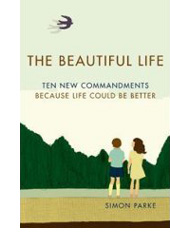 In his new book, Simon Parke has a Moses moment and offers ten new commandments for life today, which thankfully come without the fire and brimstone of old. Simon explains here why he came to write, and how he chose commandments which begin with "Be present" and end with "Fear nothing".
YOU MAY HAVE NOTICED that if you put a fence around a field of worms, it has limited impact, for it is in the nature of worms to burrow and dig. The fence may be strong, impressive, and a clear marker of intent: Worms must stay! But worms will be worms, and will soon be gone. Could the same be said of humans and external moral commands?
I had been invited to lead a weekend on the ten commandments in Dundee. I fulfilled my brief, but even as I was speaking, felt that if I had ten things to say to the human race, none of these would be there. It wasn't that they were wrong – they just weren't as prior as they might be, and in matters of vision, it is good to be as prior as possible. You build from the uttermost truths.
It was on the return train to London, therefore, just past York, that I decided to attempt some alternatives which I reckoned to be more prior. These have now been published by Bloomsbury, in a book called "The Beautiful Life – Ten new commandments, because life could be better."

THE ORIGINAL TEN COMMANDMENTS tell us what not to do. This is a fine principle. Society needs general codes of restraint, and I myself appreciate a wise soul with personal knowledge of my fault lines warning me of danger. So my query concerning the original ten is not that they are negative. Rather, it concerns their lack adventure.
The second commandment, for instance, invites us not to create idols. But would not a more adventurous call be look at the insecurities which encourage me to create idols in the first place? The same might be said of the injunction against coveting, amongst other things, my neighbour's ox. Would I not be more helped by discovering the precise nature of the unhappiness which causes me to crave ownership of the beast? After all, happy people do not covet anything. And what of the panic which becomes my busy inability to keep a Sabbath? Or the terror which causes me to give false testimony quite so often?
More important than what we do is why we do it. To this extent, my new commandments are perhaps more challenging than the original ten, not less – because like a child's hands in the soft sand, they dig beneath outward action to the inner textures from which we create our lives, and from which virtue, rather than morality, struggles to arise.
It is a necessary work. If we are familiar with the gospels, we will be aware of the strange fact that the people Jesus had most problems with those most eager for the commandments. The twisting stick in his gut was the plain pretence of it all – the climate of external purity above inner accuracy. There is fear here, and a sort of obedience – but no virtue.
THE TEN COMMANDMENTS TELL US to act as though we are good, even though we are not. As Big Brother reveals, outside our comfort zone there's not a great deal to applaud. We allow in our minds a mess of assumption and emotion we would never allow in our front room. If our front room looked like our mind we'd either run out screaming or call a contract cleaner. Thus, we become the rumour of virtue rather than the real thing, and the result is a profound psychological discomfort.
Yet even as we despair, we perhaps stand on the edge of a lost Christianity – the lost or forgotten human power to extract the pure energy of the soul from the experiences of life. This, I think, would be home for us – and is the concern of my new commands.
I don't talk much of God in the book. Like "Love", "God" has become a difficult word through misuse. Too often, those who cannot accurately describe themselves, confidently imagine they can describe God. Like chimney sweeps handling clean linen, they soil what they touch. It leaves the word "God" in some disarray.
So what are my new ten? I'm not sure they work as sound bites, for they are small doors into large courtyards, which are all the better for a guide. Like the Von Trapp family, however, they must now step up onto the stage and grasp the adventure before them: 1) Be present 2) Observe yourself 3) Be nothing 4) Flee attachment 5) Transcend suffering 6) Drop your illusions 7) Prepare for truth 8) Cease separation 9) Know your soul 10) Fear nothing.
It is a long journey home.
Order your copy of The Beautiful Life here.

| Top | SOF home © Ship of Fools 2007 |
 |
|
| |
|